What Is Su Embroidery? A Straightforward Introduction
Su embroidery is hand-stitched silk work from Suzhou, China, known for split-thread shading, almost invisible stitches and double-sided pieces. Here is what the term actually covers and what to look at first.
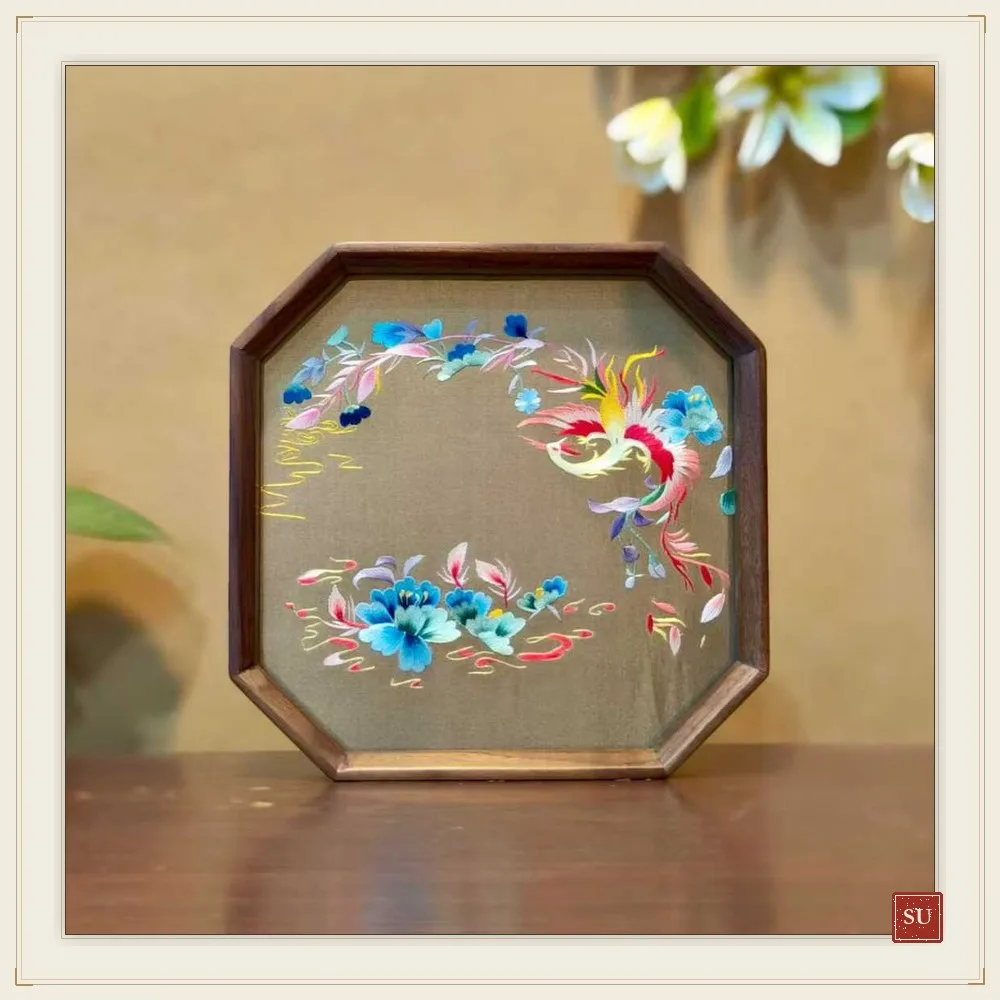
If you have arrived here from a product page, a museum label or a search for Suzhou embroidery, you are in the right place. Su embroidery (Sūxiù) is the needlework tradition of Suzhou and the surrounding Jiangnan region of China. The Su is simply the first syllable of Suzhou; it is not a style name, a brand or a grade.
The short definition is this: a picture built entirely from silk thread on a silk ground, worked by hand with a needle, where the shading is created by splitting the thread ever finer rather than by changing to a different coloured yarn. That one habit — splitting silk instead of swapping colours — explains most of what makes the finished surface look the way it does.
The name, precisely
English sources use several overlapping terms: Su embroidery, Suzhou embroidery, Suxiu and sometimes just Chinese silk embroidery. They point to the same craft, though the last one is loose enough to include work from other regions. If you need a single unambiguous phrase for searching or for a catalogue entry, Suzhou silk embroidery is the safest.
Suzhou sits in Jiangsu province, west of Shanghai, in a region that produced silk for centuries. Embroidery grew alongside that industry: the same city supplied the fabric, the thread, the dyers, the frame makers and a clientele that wanted painted-looking images on silk. It is one of the Four Great Embroideries of China, alongside Xiang (Hunan), Yue (Guangdong) and Shu (Sichuan).
What makes it look the way it does
Traditional descriptions of Su work use a cluster of qualities: flat, even, fine, dense, smooth, orderly, harmonious and lustrous. In practice that means the stitches lie in the same direction as the form they describe, the surface catches light evenly, and the transitions between two colours are gradual enough that you cannot point to where one ends.
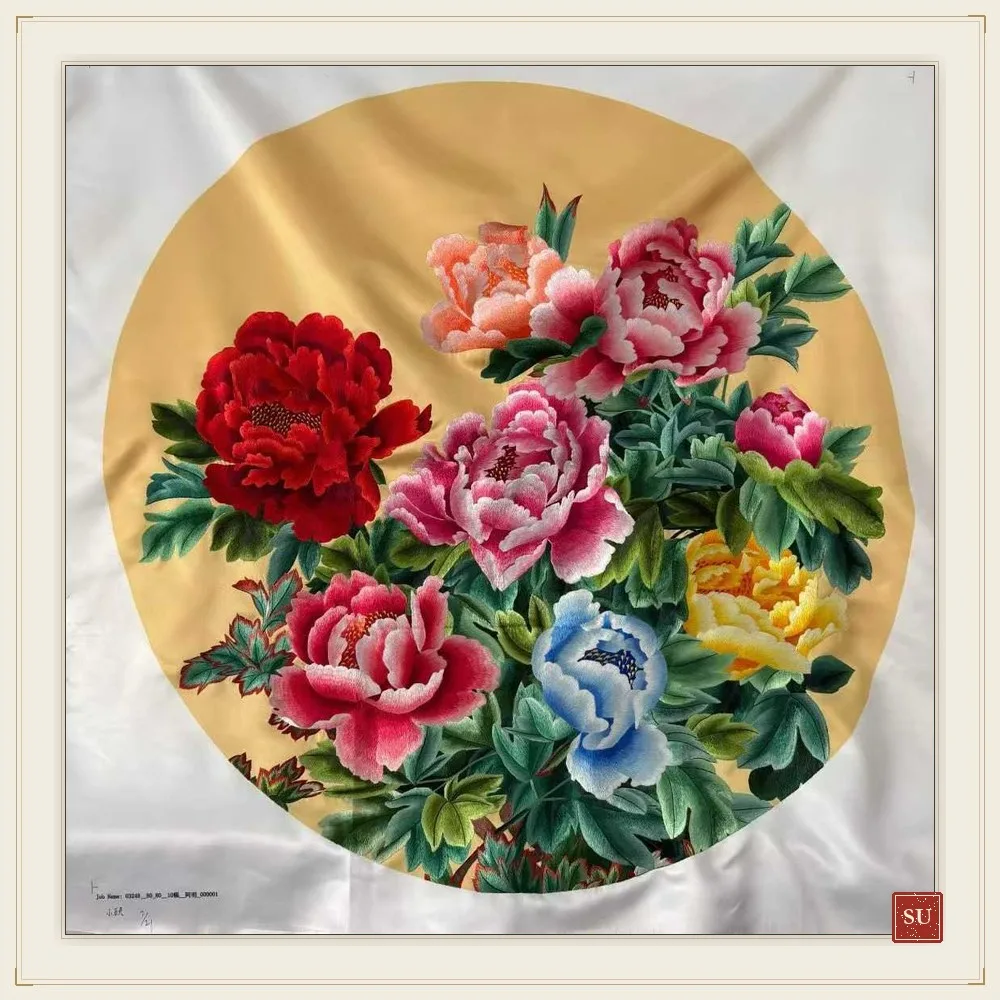
That softness is not blur. Look closely at a petal or a bird's breast and you will see thousands of short, separate stitches, each one placed deliberately. The embroiderer builds a gradient by mixing strands of slightly different shades in the same area, a technique often described as shaded or blended stitching. The effect is closer to watercolour on silk than to the flat blocks of colour you get from printed or machine-made work.
The materials are deliberately few
The ground is usually silk — a plain weave, satin or organza, chosen according to how much of it will remain visible. The thread is filament silk from the silkworm, dyed in a large range of tones. A single piece may draw on dozens of shades of one colour so that a shadow never has to jump abruptly from light to dark.
Everything else is modest: a needle with a very fine eye, an embroidery frame that holds the silk under even tension, and a paper pattern from which the outline is transferred. There is no adhesive layer, no printed base and no stabiliser in a properly hand-worked panel. That matters when you come to care for the piece, because the silk is a textile first and a picture second.
How a piece is made
A design is drawn or selected, then transferred onto the stretched silk. Thread is split by hand into fractions of its original thickness — half, a quarter, an eighth, sometimes finer — and the embroiderer begins to fill the forms. Large, open areas are worked first; the finest details, such as a bird's eye or the vein of a petal, come last and may use thread so thin it is hard to see against the ground.
Because each stitch is a physical decision, time is the main cost. A small round fan and a large landscape panel of similar apparent complexity can be many weeks apart in labour. Once the stitching is finished, the silk is removed from the frame and mounted: stretched over a backing, set behind a mount, and framed. Good mounting keeps the textile flat without crushing the stitches, which is why framing is treated as part of the craft rather than an afterthought.
Subjects you will keep seeing
Peonies, plum blossom, lotus, magnolia and birds recur constantly, as do koi, cranes, mandarin ducks, cats and ink-wash landscapes. Many carry conventional meanings — the peony for prosperity, the pomegranate for many descendants, paired ducks for companionship — but they also happen to be excellent subjects for thread: petals give an embroiderer a chance to shade, and feathers give a chance to layer fine strokes.
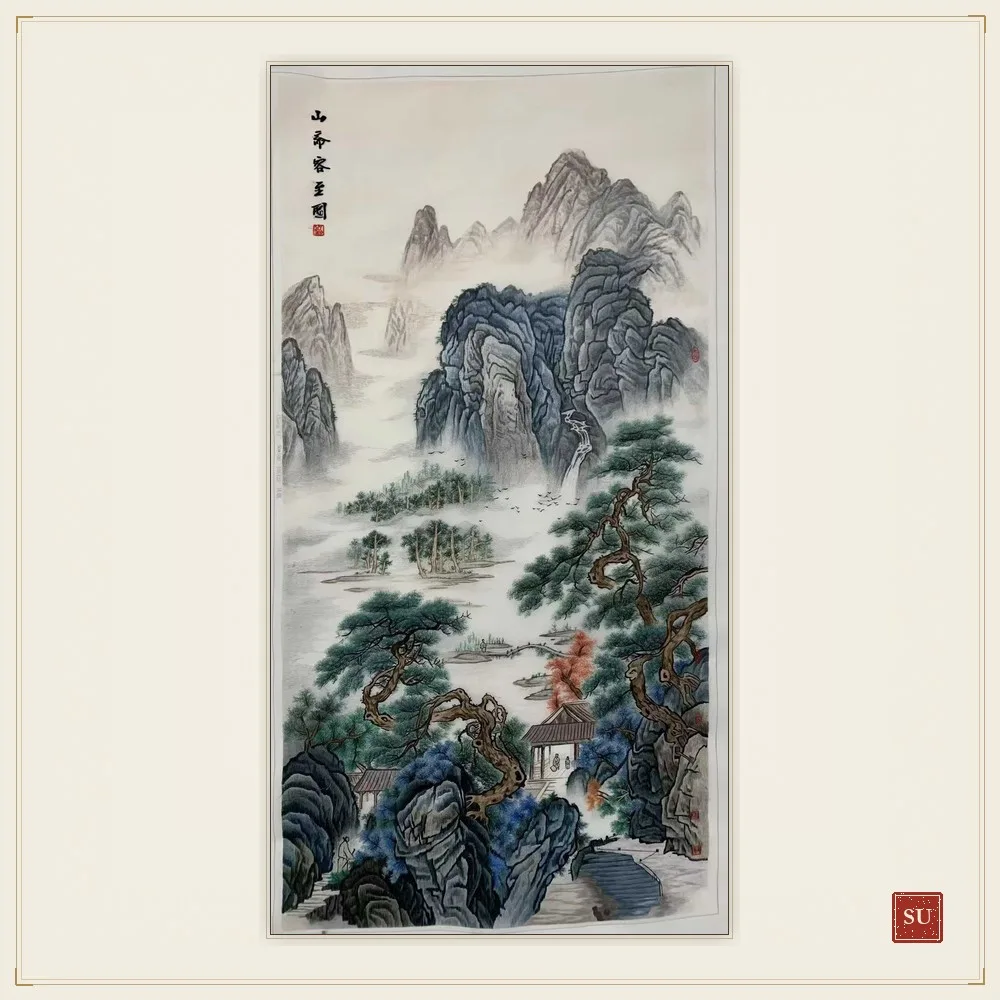
Landscape panels borrow directly from Chinese painting, including ink-wash and blue-green conventions. Those are the pieces where Su embroidery most obviously competes with brushwork: the same mist, the same receding mountains, achieved with silk filament rather than ink. If you are choosing a first piece, subject is a matter of taste; technique is what you should judge.
Is it still worked by hand?
Yes, though machine embroidery exists alongside it and the two are often confused online. A machine can reproduce an outline quickly and evenly; it cannot split a silk filament down to a hair and change direction stitch by stitch to follow a feather. The giveaway is usually on the reverse of the textile and in the way the light travels across the surface — covered in more detail in our guide to telling hand work from machine work.
Suzhou remains a working centre for the craft, with studios, training and a cluster of workshops in the Zhenhu area. Su embroidery was included in China's first national list of intangible cultural heritage in 2006. That recognition describes a living practice, not a museum relic: the stitches in a newly made panel are essentially the same stitches used a century ago.
Key takeaways
- Su means Suzhou; the term describes a regional hand-embroidery tradition, not a quality grade.
- The signature technique is splitting silk thread to build smooth shading, rather than switching between a few flat colours.
- Only silk ground, silk thread, needle and frame are involved — a finished panel is still a textile.
- Look at stitch direction, colour transitions and the reverse of the fabric before you judge a piece.
See the technique in the collection
FAQ
Is Su embroidery the same as Chinese embroidery in general?
No. Chinese embroidery covers many regional traditions. Su embroidery is specifically the Suzhou tradition, one of the Four Great Embroideries, and is distinguished by very fine split-thread shading and a smooth, even surface.
Why are hand-embroidered panels more expensive than printed silk pictures?
The cost is mostly labour. A single panel represents weeks or months of hand stitching, with thread split by hand and shading built stitch by stitch. A printed or machine-embroidered image reproduces the look in a fraction of the time.
Can Su embroidery be washed?
Not in the ordinary sense. The ground is silk and the stitches are raised; water, friction and detergents can distort the textile. Dusting, stable humidity and keeping the piece out of direct sunlight are the routine. See our care guide for the full routine.
Does every Su embroidery piece have a visible front and back?
Most panels do have a working reverse with thread ends and crossings. Double-sided embroidery is a special case where both faces are finished images, sometimes even in different colours. That is a separate technique with its own guide.