Hand Embroidery vs Machine Embroidery: How to Tell the Difference
Six concrete checks — sheen, thread thickness, transitions, reverse, repeat and edge — for separating hand-stitched Su embroidery from machine output and printed silk.
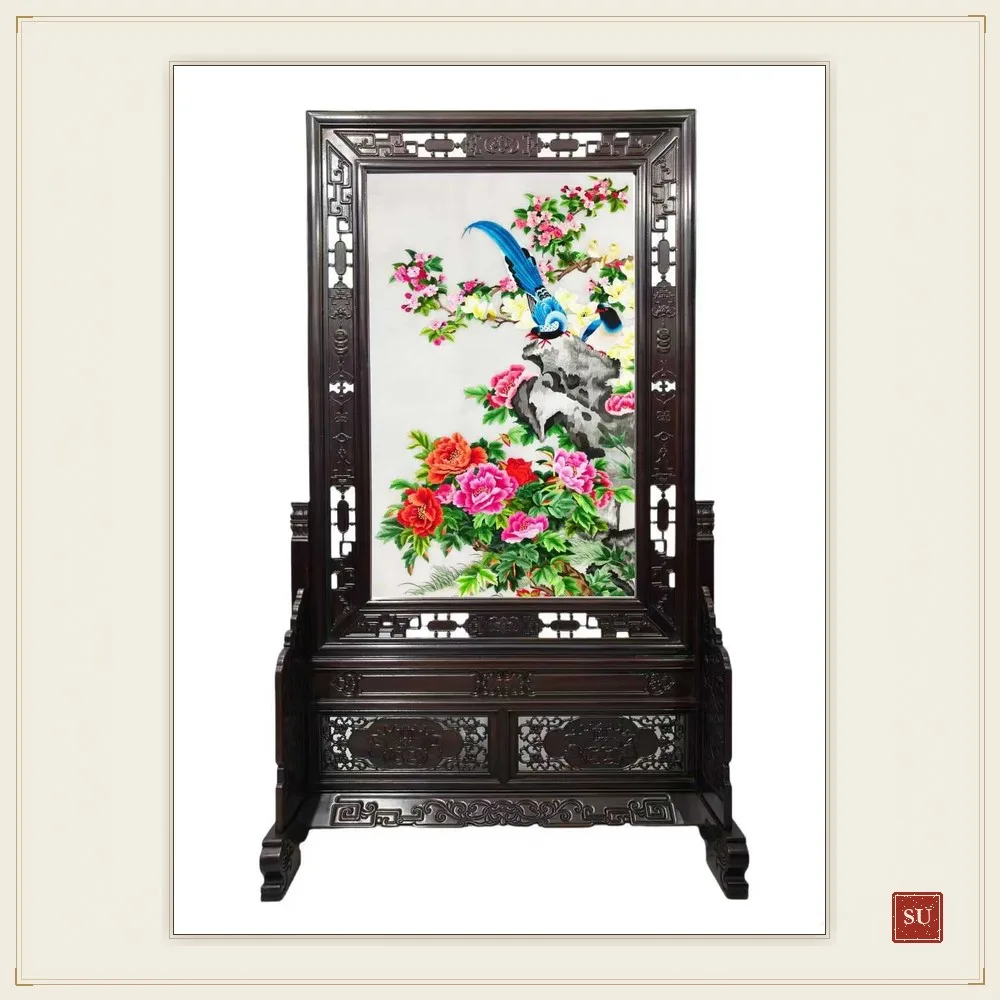
The phrase 100% handmade appears on a great many listings, including some for objects that were printed onto silk or embroidered by machine. That is not always deception; it is often a loose translation or a supplier repeating a supplier's description. Either way, you need checks that do not depend on the wording.
The six below work in ascending order of effort. The first two you can do from a photograph or across a room; the last few need a close-up, the reverse of the textile, or a direct question to the seller.
1. Directional sheen
Silk filament reflects light along its length. In hand work, the embroiderer changes stitch direction to describe a form, so a panel brightens and dims in patches as you move past it. A machine fill generally lays thread in one consistent direction dictated by the programme, and a printed image has no thread relief at all.
The test is simple: tilt the piece, or ask for a short video of someone doing exactly that. A surface that never changes is not behaving like hand-stitched silk.
2. Variation in thread thickness
Hand embroidery uses split silk — a full strand in an open area, a fraction of one in a highlight. Under magnification you can see that some stitches are visibly finer than others. Machine embroidery runs a fixed thread from a cone or bobbin; every stitch is essentially the same weight.
This is why a macro photograph of a fine detail is so useful. Look at a stamen or an eye and then at a broad petal: the difference in thread thickness should be obvious if the piece was worked by hand.
3. How one colour becomes another
A hand-worked gradient is built by layering short stitches of neighbouring shades and by reducing thread fineness, so the transition has no identifiable boundary. Machine work changes bobbins in discrete steps; printing produces a continuous tone but no stitch structure at all.
Look at the edge of a petal. If you can point to a line where one colour stops, or if the whole area is perfectly smooth with no visible threads under magnification, you are looking at one of the two alternatives. Our five-minute reading routine puts this check in context.
4. The reverse of the textile
Ordinary hand embroidery has a working back: crossings, short thread ends, occasional small knots, and a pattern that mirrors the front but is not finished as an image. Machine embroidery usually has a dense, uniform underlay or stabiliser, and its reverse looks mechanically regular. A printed panel has an untouched back.
One exception matters. In double-sided Su embroidery, both faces are finished images and all ends are hidden inside the work. If a seller describes a piece as double-sided but shows an ordinary working reverse, ask again.
5. Repetition and symmetry
A machine reproduces a digitised file, so identical motifs repeat exactly — same stitch count, same angle, same tiny imperfection, every time. Hand work carries small deviations even when the same pattern is used twice: a petal sits slightly differently, a shade is blended a little further.
This is a useful check for sets of panels, pairs of fans or repeating borders. Hold two supposedly identical motifs side by side. Perfect, pixel-level duplication is a mechanical signature, not evidence of exceptional skill.
6. Edge behaviour and the seller's answers
At the perimeter, look for how the thread terminates and how the silk is secured. Hand work ends within the stitch structure; machine work may show a locked-off run or a cut stabiliser edge. On a framed piece you may not see this, so ask whether the panel can be removed from its mount and whether photographs of the reverse exist.
Then listen to the vocabulary. A studio that can tell you which areas use finer thread, how the shading was layered, and how long the piece took is describing decisions someone made. A listing that only repeats handmade, heritage or museum quality, with no macro images, is not giving you anything to verify.
Key takeaways
- Tilt the panel: directional sheen is the fastest indicator of hand stitching.
- Under magnification, hand work shows varying thread thickness; machine work does not.
- A step-free colour transition and a working reverse are strong evidence of hand work.
- Perfect repetition across identical motifs is a mechanical signature.
- Ask for macro, raking-light and reverse photographs — a refusal is information.
See the technique in the collection
FAQ
Is machine embroidery always obvious?
Not in a small frontal photograph. Modern machines can reproduce outlines and colour blocks convincingly, which is why you need a raking-light view and one macro shot rather than a single hero image.
Are machine-embroidered silk panels worthless?
No. They can be attractive, consistent and reasonably priced decorative objects. The issue is description and price, not the object itself: a machine piece should not be sold at hand-work prices.
What about panels that are partly hand and partly machine?
Mixed production exists — for example a machine-filled ground with hand-finished details. Ask directly which parts are hand stitched and request close-ups of each; vague answers usually mean the hand contribution is small.
Can a certificate prove a piece is hand embroidered?
A certificate is only as good as the issuer and the documentation behind it. It is most useful alongside studio provenance, an invoice and stitch-level photographs, not as a substitute for them.