Splitting Silk Thread: How One Strand Becomes a Hundred Shades
The quiet skill behind Su embroidery's soft gradients: dividing a single silk filament into halves, quarters and sixteenths, then using fineness itself as a shading tool.
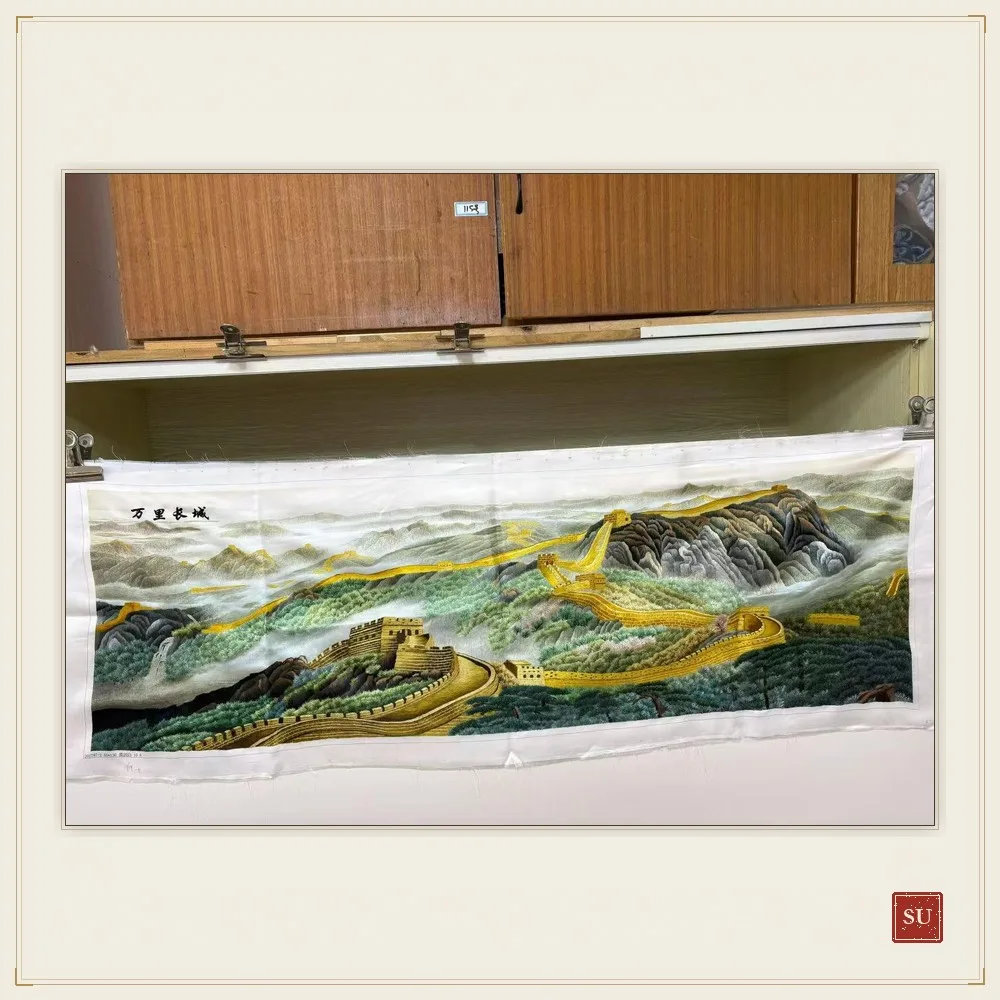
A skein of embroidery silk looks like one thread. In a Suzhou studio it is treated as a bundle: a filament that can be separated by hand into halves, then quarters, then eighths, and often finer still. The embroiderer chooses how much of the original strand to use for each area of the picture, in the same way a painter chooses a brush size.
This is the least visible and one of the most consequential skills in the craft. It explains why two panels with the same design and the same colours can look entirely different, and why a small piece can take longer than a large one.
What splitting actually means
Silk from the silkworm is a continuous filament; the thread sold for embroidery is made of many fine filaments twisted or laid together. Splitting is the act of separating those filaments by hand — drawing the strand down into two, four, eight or sixteen parts — without breaking them or changing their twist.
It is done at the frame, constantly, as the work progresses. An area of open background might use a relatively full strand, while the last highlight on a petal uses a fraction so fine that it is difficult to see against the silk ground. The embroiderer's fingers, not a tool, judge how far a strand can be divided.
Fineness as a shading tool
Colour is only one way to make a tone lighter. Making the thread thinner does it too: a hair-fine strand laid over a light ground deposits less pigment per square millimetre, so the eye reads a softer value. By combining a finer strand with a slightly different shade, an embroiderer can build a gradient with no visible steps at all.
This is why Su embroidery so often looks like watercolour rather than like counted-thread work. There is no grid, no fixed stitch size and no single thread weight across the piece. The density adapts, line by line, to what the image needs at that exact spot.
Why lustre changes with fineness
Silk reflects light along the length of the filament. A full strand gives a broad, bright highlight; a split strand gives a fine, quieter one. Put a bold full-strand stitch next to a split-strand highlight and the surface seems to have depth, even though both are the same material and the same dye lot.
An experienced embroiderer uses this deliberately in subjects with texture — the sheen on a koi's scale, the down on a duck's breast, the difference between a petal and a leaf. If you tilt a panel and some parts glint while others stay matte, you are seeing thread fineness at work, not a different kind of silk.
The cost in time
Finer thread covers less area per stitch. A passage worked with a sixteenth of a strand may need many times the number of stitches to fill the same space as a passage worked with a half strand. That is the arithmetic behind a price: labour scales with fineness, not with the outer dimensions of the frame.
It also explains why the last ten percent of a piece can take a disproportionate share of the schedule. Broad areas go down relatively quickly; the eyes, stamens, feather tips and the final tonal adjustments are worked with the thinnest thread and the smallest needle, under the most concentrated attention.
What to look for in a finished piece
Find a transition — the edge of a petal, the shading under a leaf — and look for steps. If you can see a hard line where one colour stops and another begins, the shading was probably worked with a single thread weight. If the tone seems to dissolve, someone spent time splitting and layering.
Then compare the finest detail with the broadest field. In a well-planned panel the difference in thread thickness is obvious under magnification, while the overall surface still reads as even. That combination — invisible at arm's length, clearly varied up close — is the hallmark of controlled work.
Splitting and machine embroidery
A machine works with a fixed thread and a fixed tension. It can reproduce an outline and even a passable colour gradient by changing bobbins, but it cannot divide a filament mid-stitch or decide that this particular highlight needs a sixteenth of a strand. The difference is structural, not a matter of machine quality.
That is why thread splitting is one of the more reliable things to ask a seller about. A studio that can explain which parts of a design use finer thread is describing real decisions; a listing that only says 100% handmade without any detail is not. See our comparison of hand and machine embroidery for other checks.
Key takeaways
- Splitting separates a silk strand into fractions by hand, chosen area by area at the frame.
- Thinner thread lays down less colour and less lustre, so fineness itself becomes a shading tool.
- Finer work needs far more stitches, which is why labour is driven by fineness rather than frame size.
- A smooth, step-free gradient is the visible sign that thread was split and layered.
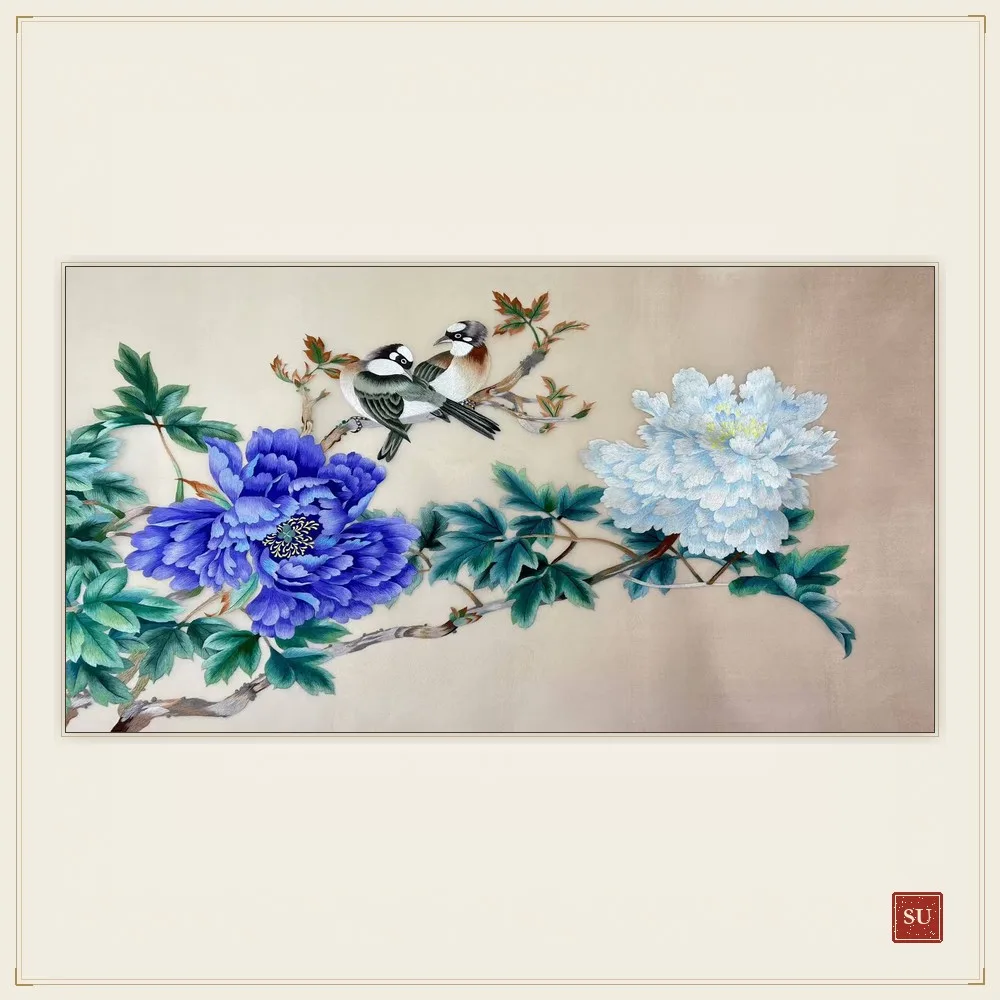
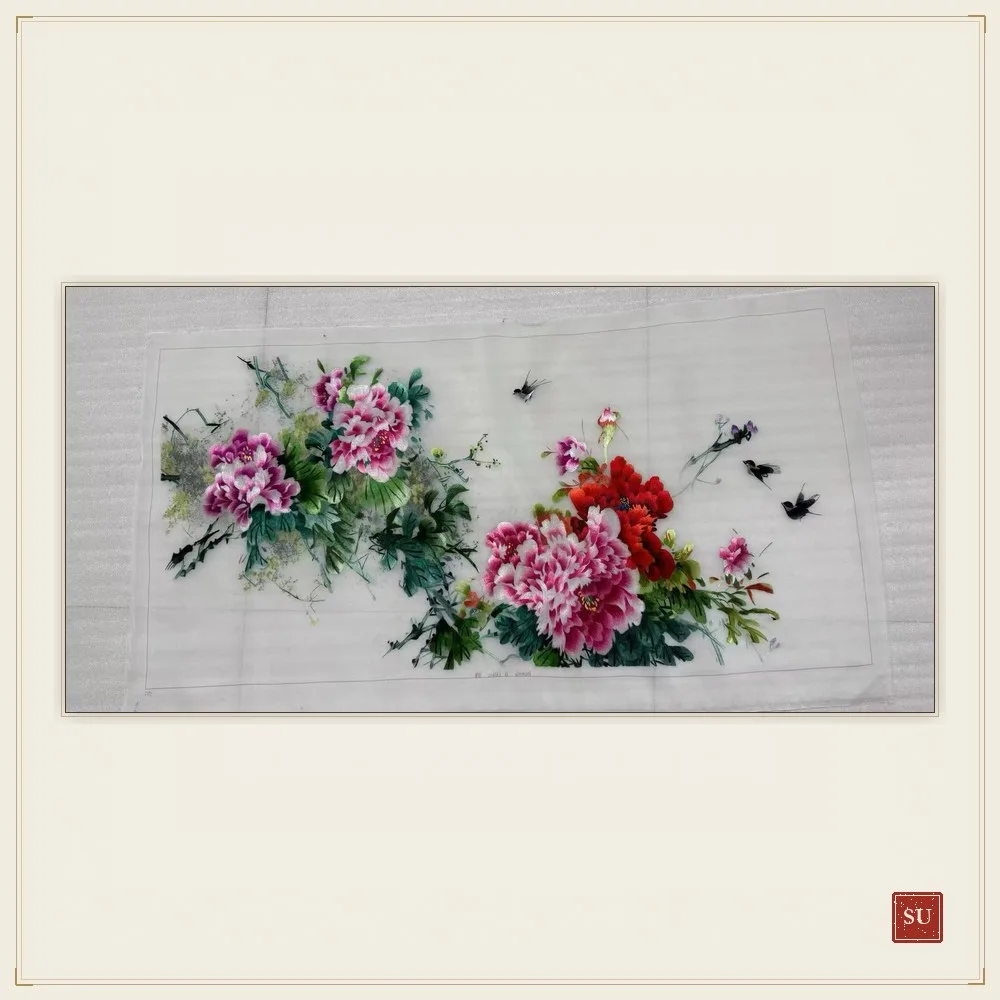
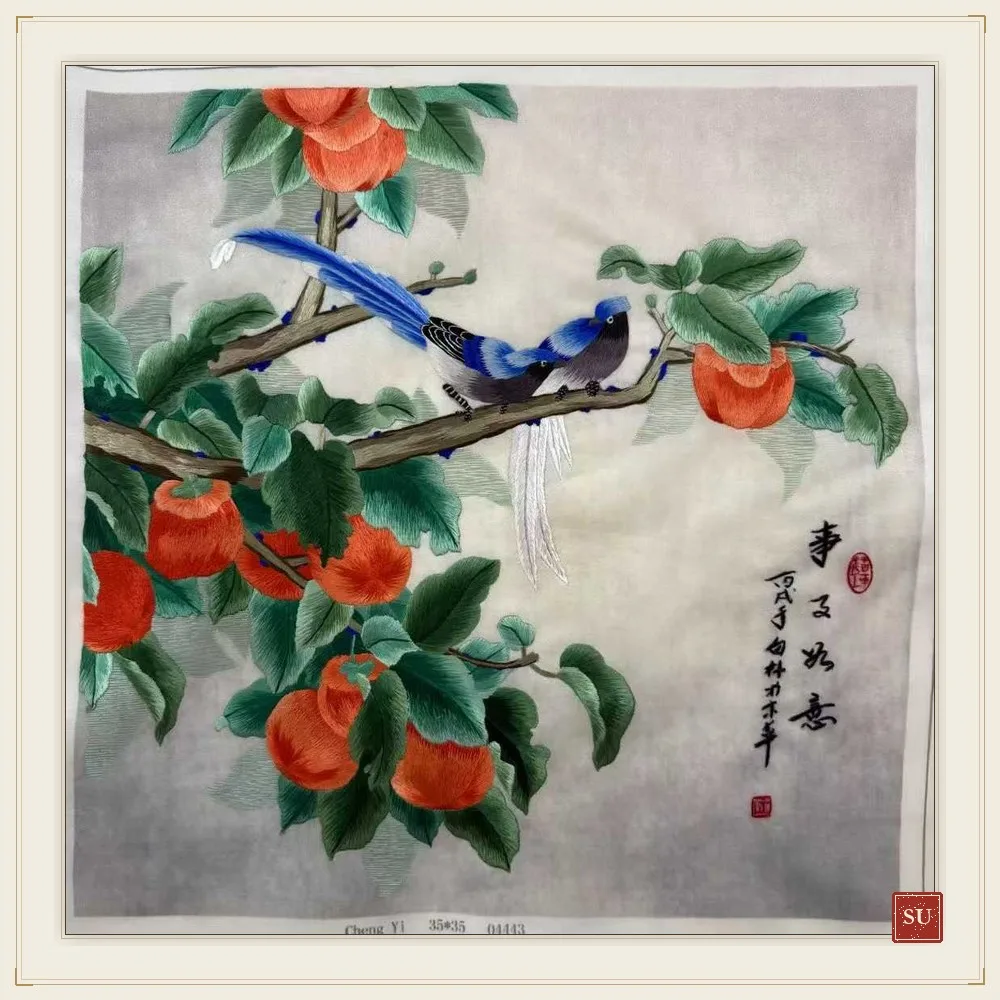
See the technique in the collection
FAQ
How fine can silk thread be split?
Common working divisions are halves, quarters, eighths and sixteenths, and very fine detail can go beyond that. The limit is dexterity rather than a fixed rule; the embroiderer judges it by hand for each area.
Does finer thread mean better embroidery?
Not automatically. It means more time and a softer possible gradient. Whether that serves the design depends on the subject — a bold ink-wash landscape may be stronger with heavier thread than a finely shaded portrait.
Why does a small panel sometimes cost more than a large one?
Because labour follows stitch count and thread fineness, not the outer dimensions. A small, densely shaded flower can require far more individual stitches than a larger, more openly worked landscape.
Can I see split thread in a photograph?
A macro shot will show that some stitches are visibly finer than others. A normal full-frame photograph will not. Ask for one close-up of a shading transition if you are buying online.