Su Embroidery Stitches: The Needlework Behind the Surface
A practical vocabulary of Suzhou embroidery stitches — flat, satin, layered, random and seed — and what each one is used for on a finished panel.
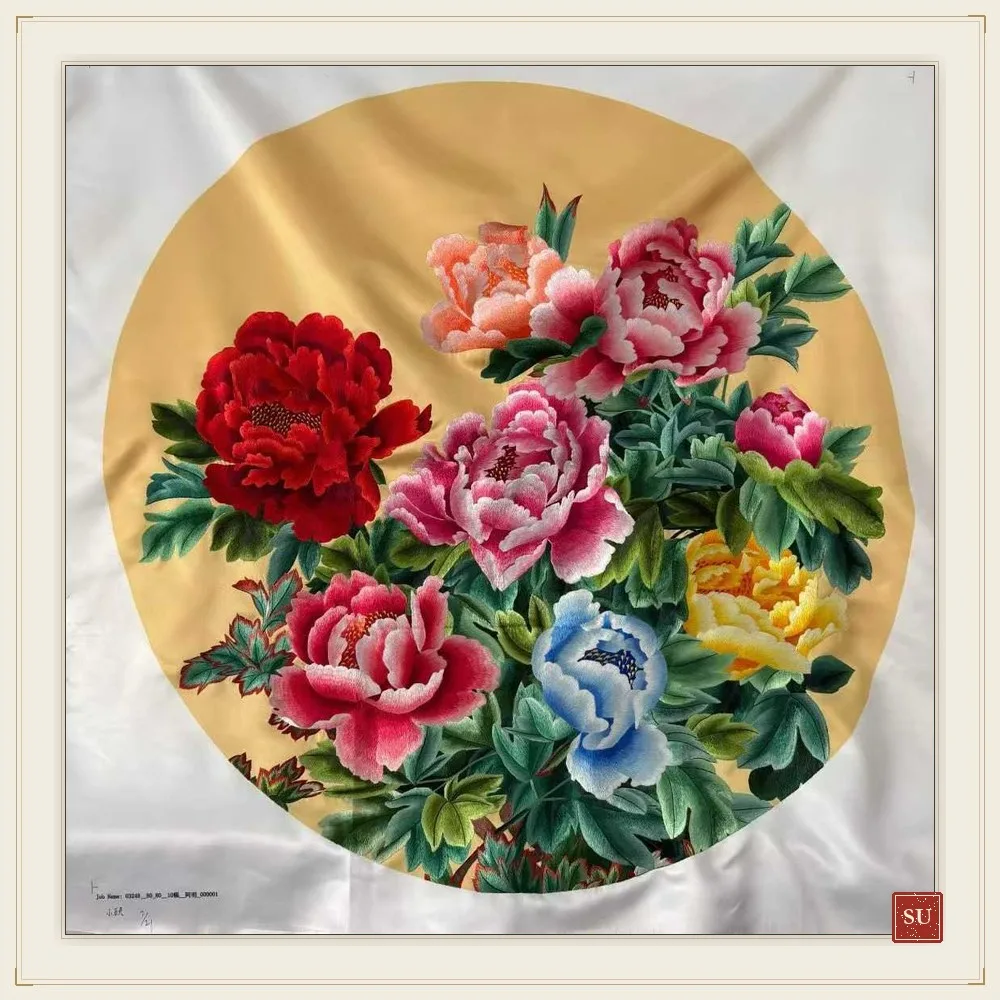
People often ask how many stitches there are in Su embroidery. The honest answer is that catalogues list dozens of named stitches, but a working embroiderer uses a much smaller set most of the time and combines them freely. What matters more than the names is direction: which way the thread lies across a form, because that is what determines how light travels over the silk.
This guide gives you the vocabulary you need to read a panel and to talk to a studio about a commission. It is not a course in stitching — it is a map of what you are looking at.
Start with the direction, not the name
Hold a piece at an angle to a window and slowly move it. Petals, feathers and fur will brighten and darken as you tilt the frame. That happens because the stitches in each area lie roughly parallel, and silk filament reflects light along its length. An embroiderer uses this deliberately: two neighbouring petals can be stitched in slightly different directions so they separate visually without any outline between them.
This is the single most useful thing to understand. A printed image looks the same from every angle. A hand-stitched panel does not. If a seller's photographs show a completely flat, unchanging surface, ask for a raking-light shot before you assume the piece is hand worked.
Flat and satin stitches: the foundation
The basic filling stitch lays short, parallel lengths of thread side by side so they just meet, covering the ground without gaps or overlap. When those lengths are longer and packed tightly to give a smooth, glossy area, English sources usually call it satin stitch. In Chinese embroidery the family is broader, with names describing exactly how the rows interlock and how the edges are tucked under one another.
The skill is not in executing the stitch but in keeping the tension identical across hundreds of them. Too tight and the silk puckers; too loose and the ground shows through. On a well-made peony you should not be able to see the individual rows as stripes — the surface should read as one continuous tone.
Layered and shaded work
To move from one colour to another, the embroiderer does not simply stop one thread and start the next. Short stitches of the new shade are worked into the gaps between the old ones, then another shade into those gaps, and so on, sometimes over several passes. Chinese descriptions of Su work often talk about even, fine and dense filling; this layering is what those words mean in practice.
Because the thread itself can be split into fractions, an embroiderer can also make a transition thinner simply by using a finer strand. Combining a finer strand with a new shade produces a gradient you cannot pick apart with the naked eye. It is slow work, and it is the main reason a small, apparently simple flower can take longer than a large, boldly outlined landscape.
Random stitch and painterly subjects
Luan zhen, usually translated as random or disordered stitch, uses crossing, irregular lengths and directions rather than neat parallel rows. It was developed to reproduce the softness of oil painting and photography — skin tones, animal fur, mist and clouds — where a tidy satin surface would look too graphic and hard-edged.You will see it in photographic-looking portraits and in landscape panels with atmospheric haze. From a distance the area seems almost knitted; up close the crossing threads scatter the light in several directions at once, which is exactly what kills the hard boundary between two tones. It is a relatively modern addition to the Su vocabulary and a good example of the tradition absorbing new source material.
Accents: seed, outline and couched details
Some things are better dotted than filled. Seed stitch — tiny knots or short loops — gives the texture of a flower's stamen, a bird's eye or the speckle on a stone. Outline stitches define an edge where shading alone would leave it vague, and couched or wrapped threads can suggest a branch, a whisker or the fine rib of a leaf.
These are usually the last marks made on a panel and the easiest to appreciate. Look at the centre of a peony or the eye of a koi: if a single tiny stitch changes the whole expression of the subject, you are looking at the most controlled part of the work, not a decorative afterthought.
What this means when you buy
Ask for a close-up photograph of two or three areas, not just a full-frame shot. You want to see a shading transition, an edge where two colours meet, and one fine detail. Those three views tell you more about workmanship than the overall composition, which can be copied from a painting.
Then compare the price against the visible density of stitch, not the size of the frame. A sparsely stitched large panel can be quicker to make than a small, densely shaded fan. Our guide to what drives value goes through the other factors — condition, subject, provenance — that sit alongside technique.
Key takeaways
- Stitch direction controls how silk reflects light; tilt a panel and watch the surface change.
- Flat and satin stitches fill forms; layered shading and split thread create gradients without hard colour boundaries.
- Random stitch (luan zhen) is the painterly technique used for fur, mist and photographic tones.
- When buying, request close-ups of a shading transition, a colour edge and one fine detail.
See the technique in the collection
FAQ
How many stitches are there in Su embroidery?
Reference books list dozens of named stitches, but most panels rely on a small working set: filling stitches, layered shading, outline work, and a few accents such as seed stitch. The combinations matter more than the count.
What is luan zhen?
Luan zhen, often translated as random or disordered stitch, uses crossing threads of irregular direction and length. It was developed to reproduce the soft tonal effects of painting and photography, and is common in portraits and misty landscapes.
Why does the same colour look different in two parts of one panel?
Because the stitches in the two areas lie in different directions. Silk filament is directional and reflects light along its length, so embroiderers use direction as a shading tool without changing the thread colour.
Can I tell stitch quality from an online photo?
Partly. A single flat, frontal photograph hides most of it. Ask for a raking-light image and one macro shot of a colour transition; those two views reveal tension, density and whether shading was layered or printed.