Double-Sided Su Embroidery: Two Finished Faces, One Silk Ground
Double-sided embroidery produces a complete image on both faces of a single piece of silk. Here is how it is worked, why some pieces show two different colours, and how to display one.
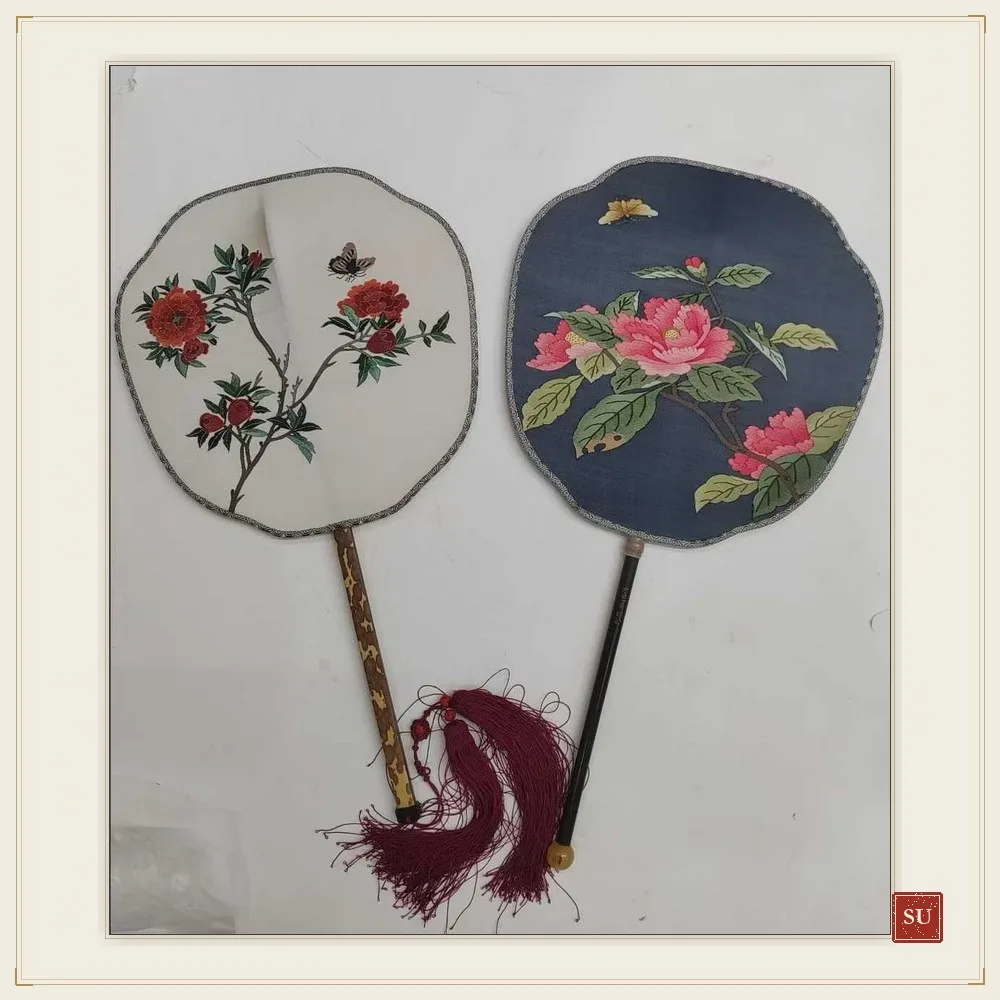
Ordinary embroidery has a front and a back. The reverse shows the working evidence: starts, finishes, crossings and loose ends. Double-sided Su embroidery does away with that distinction. Both faces are finished images, and the joins are hidden inside the thickness of the silk so that neither side reveals how the other was made.
It is one of the most recognisable achievements of the Suzhou tradition, and also one of the most commonly misdescribed. A printed silk panel that looks similar on both sides is not the same thing, and a piece embroidered twice and glued back-to-back is not the same thing either.
One ground, two faces
The embroiderer works on a single translucent layer of silk held taut in a frame, and can see through it to the other side. Every needle passage has to be planned so that the thread that builds the image on the front also builds the intended image on the reverse. There is no separate backing pass and no second piece of fabric.
The difficult part is concealment. In ordinary work you simply knot, tie off or carry a thread across the back. Here, a knot would be visible from the other side. Starts and finishes are buried within the stitch structure itself, and the thread is never allowed to travel across an area that should stay clean on either face.
Same image, different image, different colours
The simplest form repeats the same composition on both faces. A more demanding version shows two related but different designs — a cat on one side and a flower on the other, for example — arranged so that the needle paths serve both. The best-known variant uses different colour schemes on each face, so a flower may be pink seen from one side and white seen from the other.
That colour trick is not dye applied to two surfaces. It depends on thread placement: which strand sits uppermost in the silk, at what angle it passes, and how the stitches overlap. Tilt the piece and the balance can shift subtly, which is part of why these panels are usually displayed where light reaches both sides.
Why translucent silk matters
A double-sided piece needs a ground fine enough to see through while working, yet strong enough to hold dense stitching. Organza and fine silk gauze are typical. The fabric is part of the optical effect: light passing through it makes the colours read differently from each side and gives the finished panel a faint luminosity that an opaque ground cannot produce.
This is also why these pieces are usually mounted in open frames, round fans or table screens rather than pressed against an opaque backing. If you put a solid board behind one, you lose half the point — and half the viewing positions.
How to display it
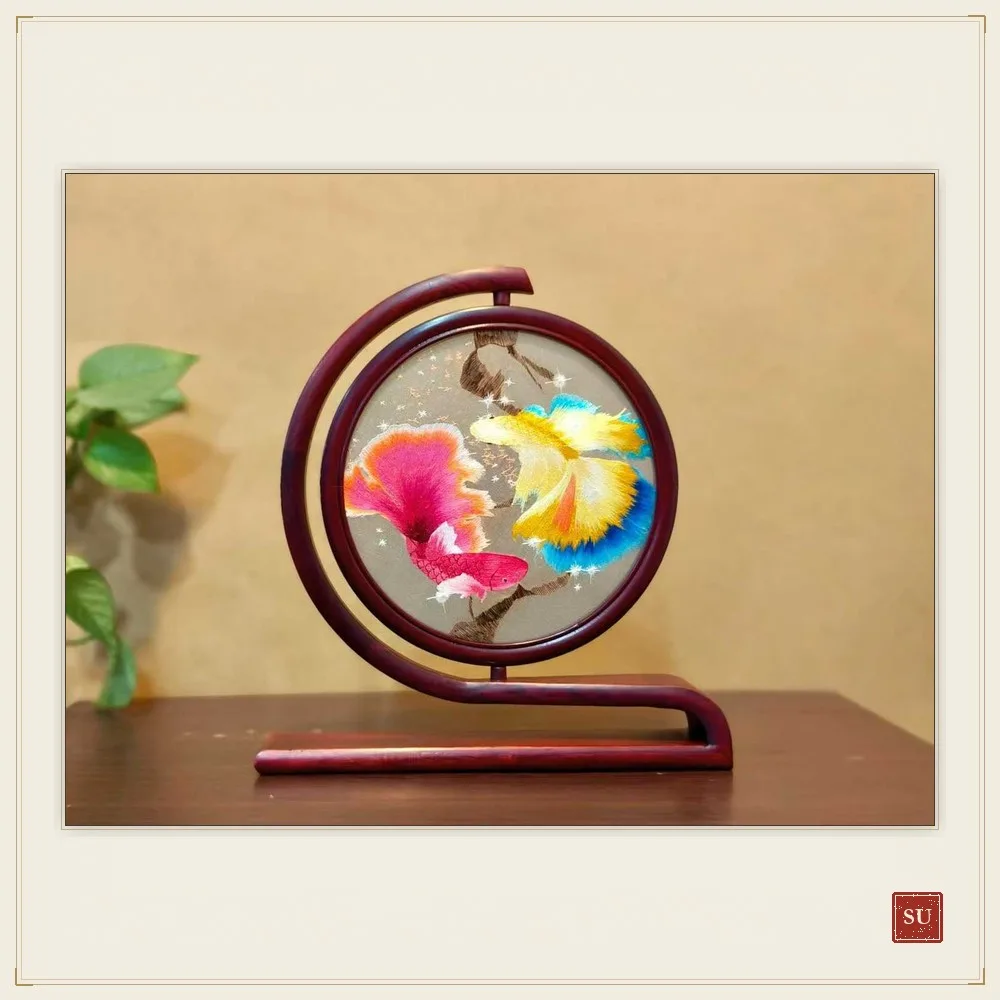
A rotating stand, a double-glazed frame or a freestanding table screen lets a viewer walk around the piece. If you hang it on a wall, leave a small gap behind the frame so light can come through, or place it near a window where daylight falls across it from the side. Avoid a tight, dark-backed shadow box.
Direct sun is still the enemy: silk fades and the fine ground becomes brittle over time. Aim for bright indirect light. A round fan or small screen is easy to turn occasionally, which also lets you check both faces for dust. Our care guide covers the routine in full.
How to check a claim
Ask for photographs of both faces from the same angle, plus one edge-on shot. A genuine single-ground piece is thin — essentially one layer of silk plus thread — and the two images will share the same outline. If the object is visibly thick, or if the two sides are perfectly identical down to the smallest highlight, suspect two separately made faces or a print.
Also look at the stitch density at the edges. Because every thread end must be hidden inside the work, the perimeter of a double-sided piece tends to be exceptionally tidy. It is a useful, quick check when you cannot examine the panel in person.
Is it always more valuable?
Usually it commands a premium, because the planning and the hidden finishes add substantially to the time. But the usual rules still apply: a small, finely worked double-sided piece can be more desirable than a large, coarse one, and condition matters more than novelty. A damaged ground is difficult to repair precisely because both faces are finished.
If you are buying your first double-sided piece, start with a fan or a small table screen. They are easier to light, easier to turn, and let you learn what to look for before committing to a large framed panel.
Key takeaways
- A true double-sided piece is one layer of silk, not two embroidered faces joined together.
- Every thread end is hidden inside the stitch structure; there is no working reverse.
- Two-colour effects come from thread placement and angle, not from dyeing the two sides differently.
- Display in an open frame or table screen with indirect light so both faces can be seen.
See the technique in the collection
FAQ
How can the two sides show different colours?
The embroiderer controls which coloured strand lies uppermost in the translucent silk and the angle at which each stitch passes. The two faces therefore reflect different threads. It is a placement effect, not a surface treatment.
Is a double-sided piece two panels glued together?
No. That would be a different, much simpler object. A genuine double-sided embroidery is worked on a single translucent ground, which is why it is so thin and why the thread ends must be concealed inside the stitches.
Can double-sided embroidery be framed against a wall?
It can, but you lose the effect. An open frame, a rotating stand or a table screen is better, with a little space behind the silk and bright indirect light rather than direct sun.
Are double-sided pieces always more expensive?
They generally are, because of the extra planning and finishing time. But fineness, condition and subject still matter, and a damaged double-sided ground is harder to restore than an ordinary panel.