Why Suzhou? Silk, Water Towns and a Needle Art
The geography behind the craft: how the lower Yangtze silk economy, garden culture and pattern-drawing workshops gave Suzhou embroidery its particular character.
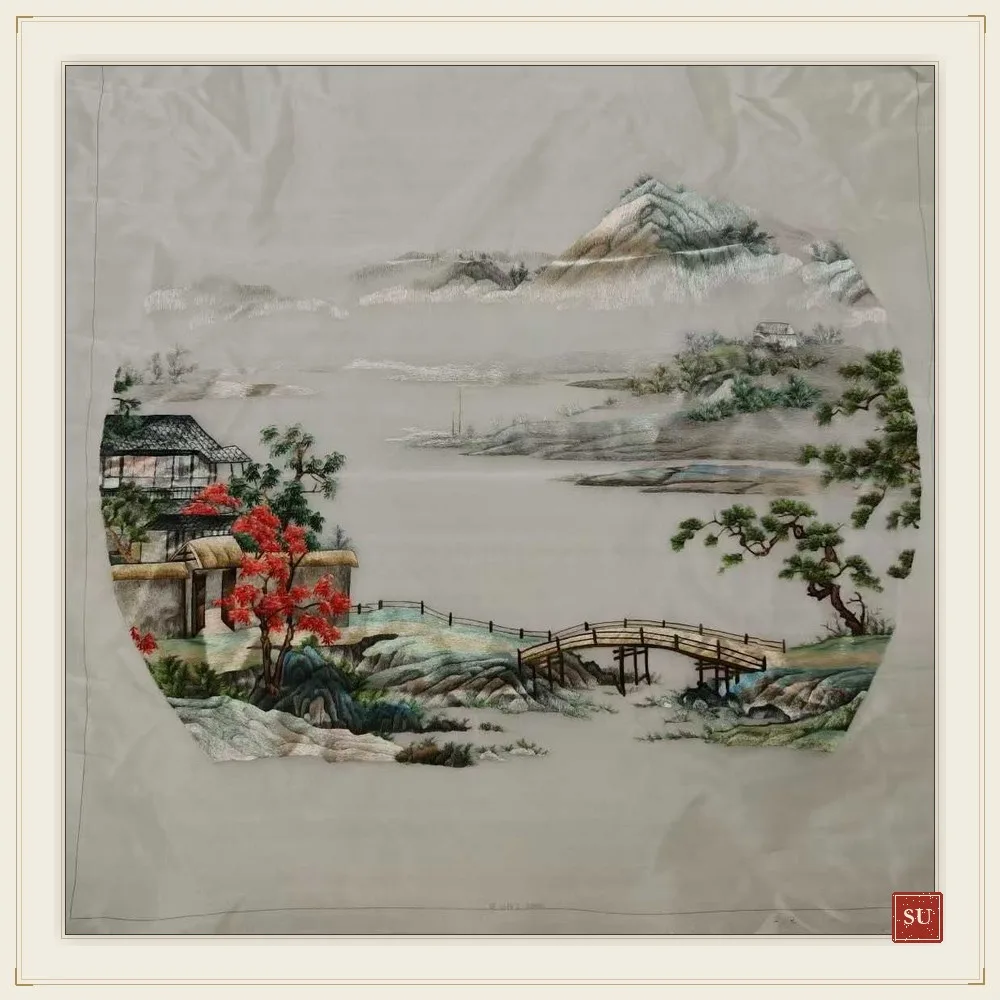
Ask why a particular needle technique became famous in one city and the answer is rarely about the needle. It is about supply. Suzhou had silk in every form — raw filament, woven ground, dyed thread — plus the craftsmen who could build a frame and the patrons who would pay for a picture made of it.
This guide is about that background. It explains why Su embroidery looks painterly, why its subjects are what they are, and why the tradition survived industrialisation when so many local crafts did not.
A complete supply chain in one region
Sericulture, reeling, weaving and dyeing in the lower Yangtze delta were not separate industries so much as neighbouring stages of one industry. An embroidery workshop could choose a ground fabric and have thread dyed to a set of shades without dealing with distant suppliers. Consistency of material is a precondition for very fine work: you cannot split a filament predictably if every batch behaves differently.
That proximity also supported experimentation. When a design needed a softer tone, the answer could be a finer strand or a slightly different dye lot — both options available locally. The technical vocabulary of split silk shading grew in exactly that environment.
Gardens, albums and the painted image
Suzhou's garden culture and its community of painters and collectors supplied the other half of the equation: source material. Album leaves, hanging scrolls and decorative schemes gave embroiderers compositions to interpret, and a clientele that recognised the references.
This is why so much Su work depicts a branch seen close up, a bird on a flowering twig, or a misty river landscape rather than a symmetrical folk motif. The embroidery is trying to do what ink and colour on paper do — hold a composition together with empty space, suggest distance, and let a single detail carry the picture.
Objects for rooms, not just for walls
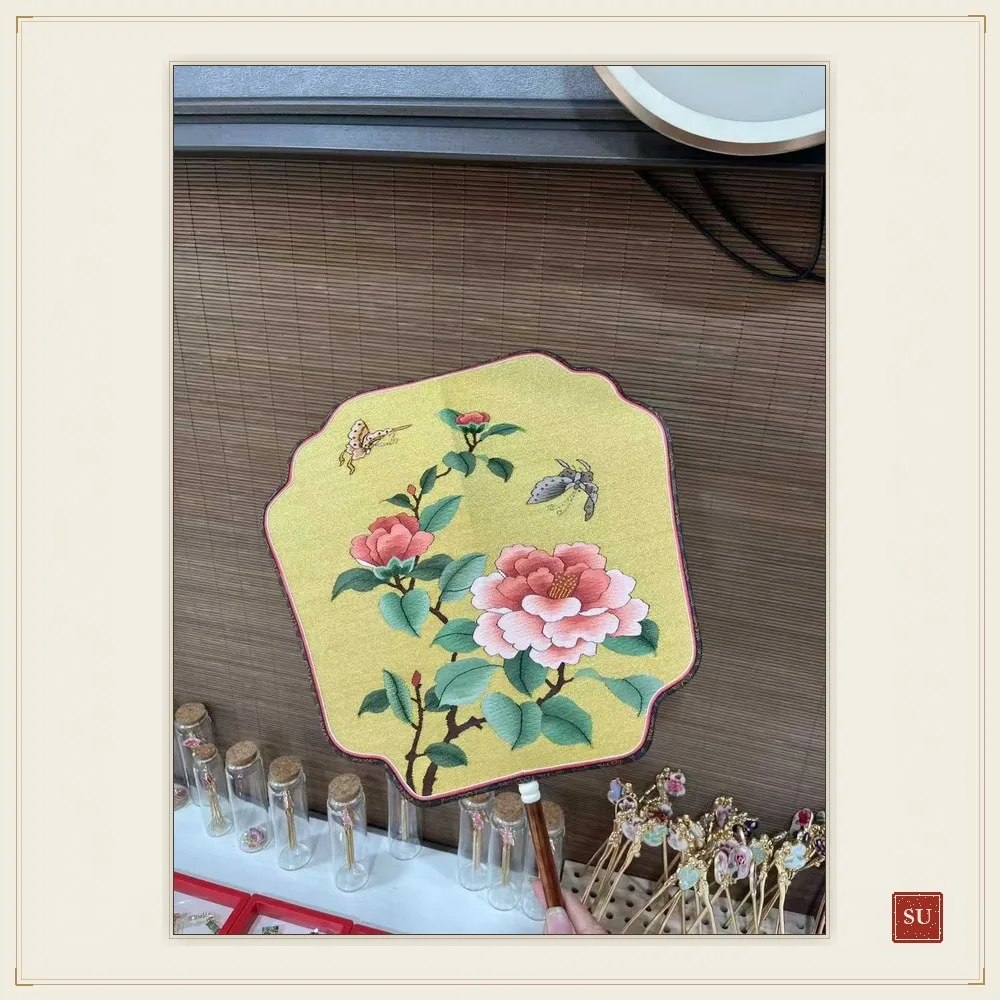
The tradition produced more than framed pictures. Screens, fans, table screens, handkerchiefs, small gift panels and accessories all belong to the same world of use. A round fan is embroidered because it will be held and turned in the light; a table screen because it will be seen from both sides at close range.
Thinking about format changes how you judge a piece. Fineness that would be wasted on a large wall panel is exactly right for a twenty-centimetre fan examined at arm's length. The collection reflects this: the same subjects appear at several scales because they were made for different distances.
Workshops and the division of labour
As demand grew, tasks separated. Someone drew and transferred the pattern; someone selected and dyed thread; embroiderers specialised in particular subjects — one hand for flowers, another for landscapes or animals; and a finisher mounted the silk into its frame. A single object could pass through several workshops.
That structure survives in adapted form. Modern studios still keep pattern libraries and still allocate work by subject, which is why a commission for a complex landscape may take a different route through the studio than a floral fan. It also explains why provenance — which studio, which embroiderers — can matter as much as the technique.
Zhenhu and the contemporary cluster
Today the best-known concentration of Su embroidery activity is around Zhenhu, on the western side of Suzhou: studios, training, suppliers and showrooms in a compact area. Clustering is not nostalgia; it is still the most efficient way to run a craft with many specialised inputs and a long training cycle.
It is also where the 2006 intangible-heritage designation has the most visible everyday meaning. The listing did not freeze a historical technique; it named an existing network of people who teach, stitch, mount and sell. Buyers who ask which studio made a piece are asking a question that still has a practical answer.
What the geography gives you as a buyer
Two useful expectations follow. First, the craft is object-based: framing, format and viewing distance are part of the design, so treat the mount as part of the piece rather than packaging. Second, the craft is collaborative: ask about the studio and the design source, not only whether it is handmade.
If you want to continue with the chronology rather than the place, our short history picks up the thread. If you want to understand how the region's silk is actually handled at the frame, go to the introduction to the craft.
Key takeaways
- Suzhou's advantage was a complete local silk supply chain — ground fabric, filament, dyeing and frame making.
- Garden and painting culture supplied pictorial compositions and a clientele that understood them.
- Screens, fans and small panels were designed for close, turned-in-the-light viewing, not only for walls.
- Specialised workshop networks persist today around Zhenhu and still shape how commissions are made.
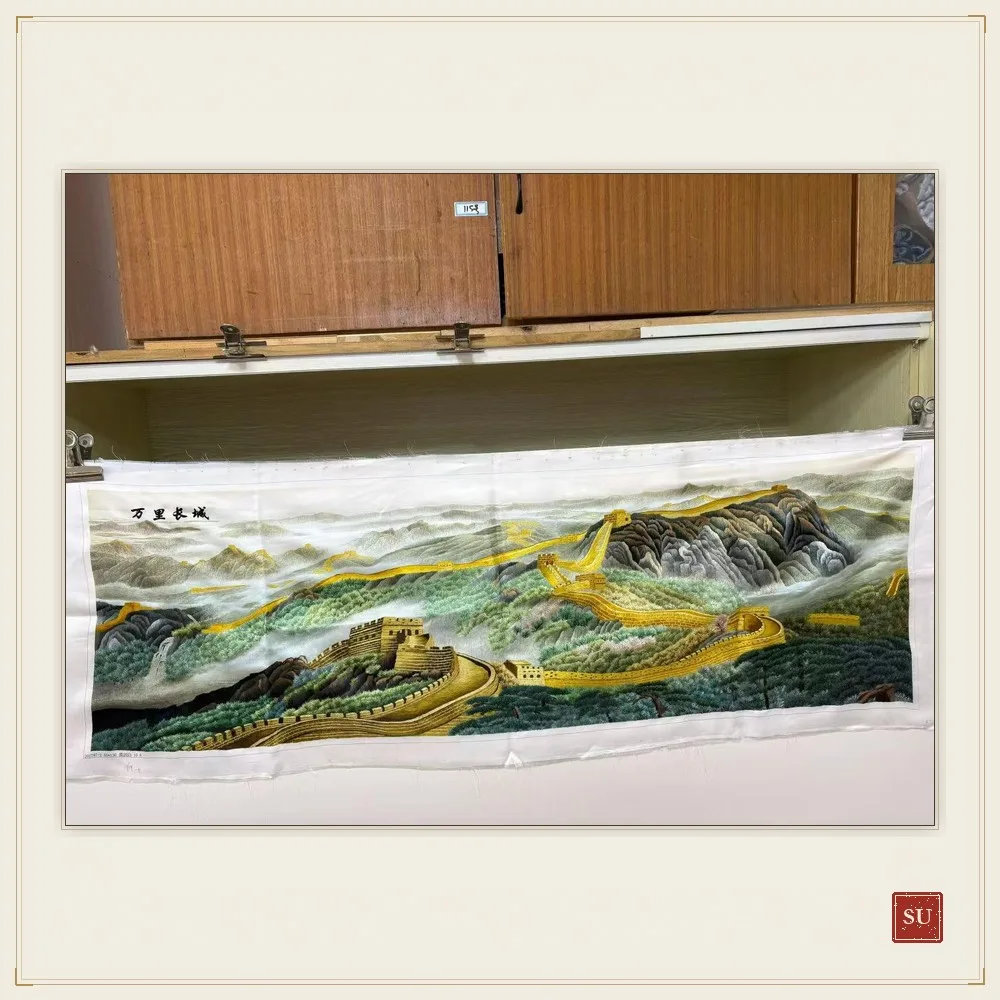
See the technique in the collection
FAQ
Why is Su embroidery associated with Suzhou specifically?
Because the region combined silk production, dyeing, weaving, pattern drawing and a wealthy market for decorated interiors. That concentration of materials and skills made very fine, pictorial needlework commercially viable.
What is Zhenhu?
An area on the western side of Suzhou with a dense concentration of contemporary embroidery studios, training, suppliers and showrooms. It is the best-known current centre of Su embroidery production.
Did Su embroidery come from folk craft or from court workshops?
Both influences are present. Domestic needlework, commercial urban workshops and elite patronage all contributed; the mature style reflects painting-based designs as much as folk motifs.
Why do so many Su pieces depict Jiangnan landscapes?
Because embroiderers drew on the painting traditions and scenery around them. Mist, water, gardens and distant hills also happen to be excellent subjects for split-silk shading.