


Double-Sided Embroidery: Two Finished Faces on One Silk
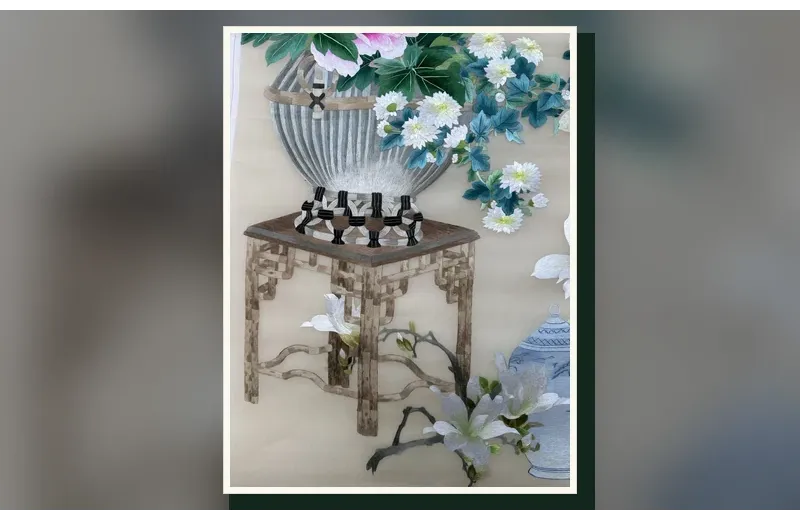
In ordinary embroidery there is a front and a back. In double-sided Su Xiu (shuang mian xiu) there are two fronts: both faces of a single piece of translucent silk carry a complete, equally clean image.
The basic problem
Every time a needle passes through fabric it leaves a thread end or a short travel on the reverse. Double-sided work has nowhere to hide them. The embroiderer must start and finish each thread inside the thickness of the ground, keep all travelling threads buried, and control tension so that neither face puckers. The work is done on a frame that allows access from both sides, and the maker constantly turns the frame to check the other image.
Two images, one set of stitches
Some pieces show the same composition on both faces — a cat seen from either side of the screen. More demanding versions show different colours or even different subjects on the two faces, using the same passages of thread. That requires planning the stitch path in advance so that a thread appearing as, say, a dark branch on one side becomes an appropriate tone on the other.
- Translucent silk ground. Fine, evenly woven silk lets both faces read cleanly without a lining.
- Hidden ends. Thread is started and finished within the fabric layers; no knots are visible on either side.
- Balanced tension. Pull too hard on one face and the other distorts — the whole piece must stay flat.
How to check a piece
Look at both faces in good light. The outlines should be equally crisp, the shading equally smooth, and there should be no visible knots, long thread runs or backing fabric. Tilt the piece: because there is no hidden reverse, the light should behave consistently on both sides. Ask the seller for a photograph of the reverse — a genuine double-sided piece has nothing to hide and sellers are usually glad to show it.
Time and value
Double-sided work is among the slowest forms of Su Xiu. A modest circular screen can occupy one experienced embroiderer for around three months; larger or two-subject pieces longer. The extra time is not decoration — it is the constraint of hiding every thread while keeping both faces perfect.
Browse double-sided embroidery pieces, or read the in-depth guide.