


Hand Stitching vs Machine Embroidery: 7 Ways to Tell
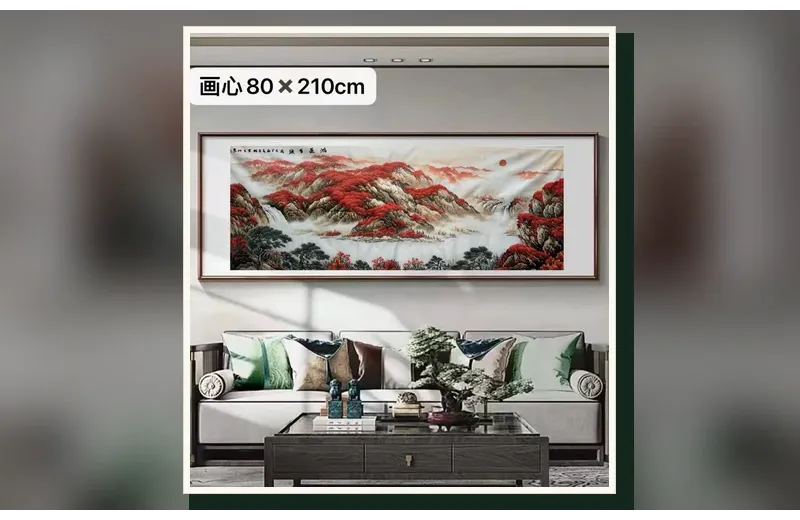
Photographs online can make a machine-made piece look convincing. In person, the difference is usually obvious within a minute — if you know where to look.
1. Turn it over
The reverse is the most honest part of any embroidery. Hand work shows short thread travels, small knots or ends, and stitches that stop where a colour stops. Machine work shows long parallel runs of thread crossing areas where the colour does not change, and often a stabiliser or mesh fused to the back.
2. Look for slight irregularity
Hand stitches vary a little in length, angle and tension, because a person placed them. That variation is not a defect — it is what gives the surface its life. Machine stitches are mathematically even. If every stitch in a large area is identical, be sceptical.
3. Examine a colour transition
In hand-stitched Su Xiu, two shades are interleaved over a band: stitches of the lighter and darker tone mix into each other, so the eye blends them. In printed or machine-rendered work, the boundary is either a hard line or a smooth digital gradient that looks the same on both sides of the image.
4. Move the light
Silk stitches have direction. Tilt the piece near a window and the same area will lighten or darken as the stitches catch the light differently. A print looks the same from every angle. This single test catches most printed imitations.
5. Check the finest detail
A whisker, a stamen or a feather barb worked in split silk will be a single fine filament, slightly tapered and slightly organic. Machine work either omits that level of detail or renders it with a uniform thickness that reads as a line rather than a stitch.
6. Ask about the process
A genuine maker can show progress photographs: the outline on the frame, half-finished shading, the piece before mounting. If a seller offers a "hand embroidery" piece in dozens of identical sizes, all available immediately, the supply chain is worth questioning.
7. Sanity-check the time and price
One mid-sized panel takes an experienced embroiderer around three months. A price that ignores that labour is telling you something. This is not a rule about quality — it is arithmetic.
Why it matters
Hand embroidery is not automatically "better looking" to every eye. It is a different object: one-off, slow, and with a surface that changes as you move. Buy it because you want that, and check it so you know what you are getting.
Related: reading the reverse of a panel and certificates and provenance.