


The Four Great Chinese Embroideries, and Where Su Xiu Fits
Chinese writers group the country's best-known regional needle traditions as the "Four Great Embroideries": Su (Suzhou), Xiang (Hunan), Shu (Sichuan) and Yue (Guangdong). Each grew out of a local silk economy and a local visual taste.
Su Xiu — Suzhou, Jiangsu
Su Xiu is the most painterly of the four. Fine split silk, close flat stitches and a very large shade library produce smooth gradients, delicate animals and ink-wash landscapes. Double-sided embroidery, where both faces of one silk ground are complete images, is its best-known technical feat. The overall impression is quiet, precise and refined.
Xiang Xiu — Hunan
Xiang embroidery is known for bold, vigorous compositions, often lions, tigers and landscapes, with strong colour contrasts and a more textured surface. It draws on Hunan folk painting and uses a range of stitches that give the work a noticeably more sculptural feel than Su Xiu.
Shu Xiu — Sichuan
Shu embroidery is traditionally bright, tidy and decorative, with pandas, flowers, birds and fish among its classic subjects. Stitches are even and tightly controlled; the charm lies in crisp outlines, cheerful colour and a highly orderly surface.
Yue Xiu — Guangdong
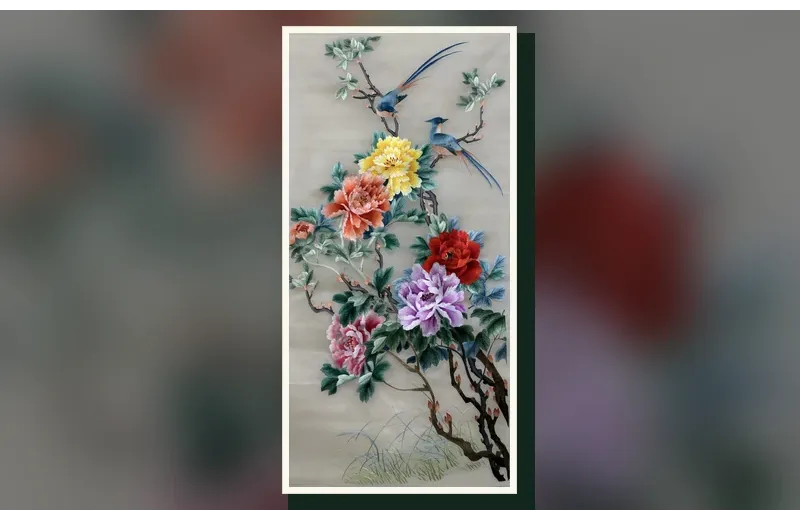
Yue embroidery tends toward rich, crowded compositions — birds of paradise, peonies, phoenixes — often with gold or metallic thread and strong decorative impact. Its history is tied to Guangzhou's export trade, so it absorbed foreign tastes and materials early.
Why Suzhou became the reference point
Suzhou had an unusual concentration of advantages: a long-established silk industry, skilled dyeing, wealthy households and a strong painting culture in the Jiangnan region. Patronage and competition pushed embroiderers toward ever finer thread and ever smoother shading. Later, studios deliberately set out to reproduce paintings and photographs in silk, which required a level of colour control that became Su Xiu's international signature.
Does the label matter when buying?
It matters less than the object in front of you. A label tells you which tradition a piece claims; it does not tell you whether it was hand-stitched. Check the reverse, the stitch variation and the behaviour of the silk under changing light, and ask for clear photographs of the work in progress. For a practical checklist, see How to Read the Back of a Hand-Stitched Panel.
Continue with a short history of Suzhou embroidery.