


Landscape in Silk: How Ink Wash Becomes Embroidery
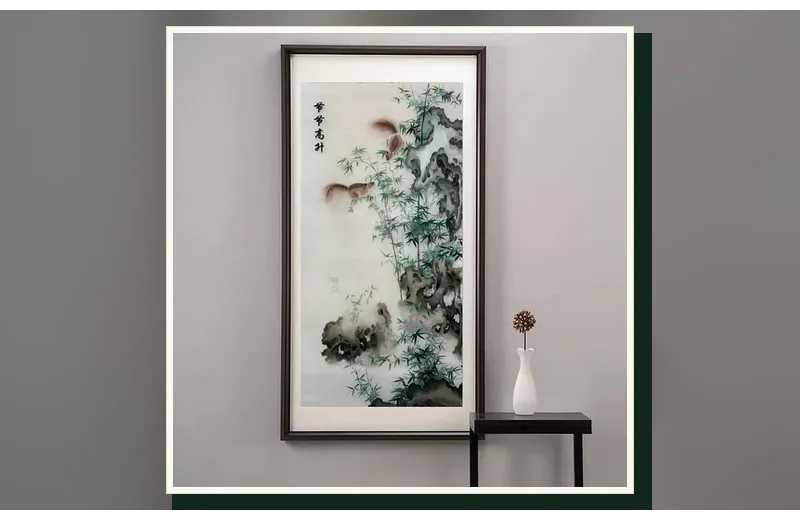
In an ink painting, the emptiest part of the paper often carries the most meaning. Translating that emptiness into thread is one of the hardest problems in Suzhou embroidery.
The problem with mist
A painter leaves paper bare for mist, or lays down a single diluted wash. An embroiderer has no bare paper — there is always a silk ground, always a stitch, always a thread with a direction and a sheen. So the "empty" areas must be constructed: a few sparse stitches, a paler grey, silk left deliberately exposed, and a careful softening of every edge so the eye reads distance rather than an unfinished patch.
Building depth
- Graded greys. Long runs of near-adjacent cool and warm greys carry mountains from near-dark foreground to almost-white distance.
- Void-and-solid stitch. Dense areas alternate with sparse ones so the ground contributes to the image.
- Random stitch for texture. Crossed, layered stitches break up rock faces and foliage without hard outlines.
- Rolling stitch for line. Short following stitches describe a ridge, a branch or the curve of a waterfall.
- Scale. Tiny figures, boats or pavilions are worked with the finest split filaments — often just a handful of stitches each.
Composition before stitches
Because a landscape contains large quiet areas, any change to the outline or the tonal plan is expensive to undo. The composition is adapted and the shade sequences are fixed before stitching begins — see From Painting to Silk. The embroiderer then works from the farthest plane forward, continually stepping back to judge whether the depth still reads.
Why landscapes take longer
A floral panel concentrates detail in a few areas. A landscape spreads fine tonal decisions across the entire surface, including the parts that are supposed to look like nothing. It is one reason a detailed mountain-and-water piece often sits at the longer end of the typical three-month range for a single maker.
How to look at one
Start two metres away: does the mist recede? Then move close: are the transitions made of interleaved greys rather than a smooth printed gradient? Finally walk past it: does the light change across the ridges? If all three work, you are looking at genuine hand-stitched silk.
Explore Silk Panels or read the guide to motifs.