


Pure Silk Thread
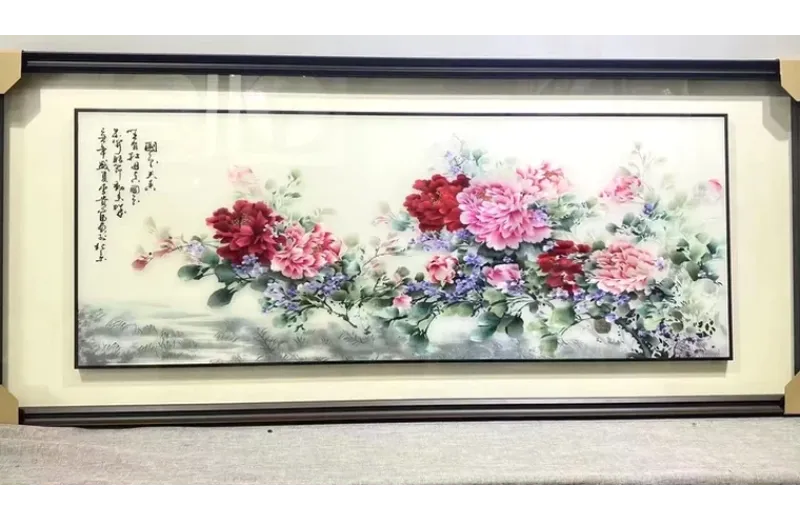
The soft, almost photographic gradients of Suzhou embroidery come from one material decision: the thread is pure silk, and it is split far finer than the strand that leaves the cocoon.
One strand, many filaments
A raw silk thread is made of many fine filaments twisted together. A Su Xiu embroiderer does not use it as it comes. She splits it by hand — commonly into a half, a quarter, an eighth, and in fine work down to a sixteenth or even smaller — until the filament is thin enough to disappear into the silk ground. The finer the filament, the smoother the transition between two colours and the less visible each individual stitch becomes.
This is also why a hand-stitched panel can carry detail that a printed image cannot: a highlight on a bird's feather may be worked with a filament a fraction of the width of the surrounding stitches.
Hundreds of shades, not a fixed palette
Su Xiu does not work from a box of 40 colours. A studio keeps a library of silk skeins dyed in many gradations of each hue — pale ivory through warm ochre, or the six or eight greens needed for a single bamboo leaf. For a landscape, an embroiderer may select dozens of near-identical greys to move from mist to mountain with no hard edge.
- Shade matching happens before stitching. Skeins are laid against the painting in daylight and grouped into graded sequences.
- Transitions are built by interleaving. Two neighbouring shades are stitched into each other, so the eye blends them rather than seeing a boundary.
- Direction changes the colour. The same silk looks lighter or darker depending on which way the stitches lie — an effect embroiderers use deliberately.
Why this takes months
Splitting thread, re-threading a needle for every shade change and keeping dozens of shades sorted is slow work. It is a large part of the reason a single hand-stitched panel occupies one embroiderer for around three months. Nothing about the process can be safely hurried: a rushed shade change leaves a visible line that cannot be undone without unpicking the surrounding area.
Care implications
Silk is a protein fibre. It is strong, but prolonged direct sunlight fades dyed shades and dry air makes filaments brittle. Keep a framed panel out of strong sun, avoid damp walls, and never wipe the embroidered surface with a wet cloth. For full guidance see Framing and Caring for Silk Embroidery.
Curious how thread becomes technique? Read Splitting a Silk Thread and the Su Xiu stitch vocabulary.