


A Thousand Shades: Dyeing and Matching Silk Thread
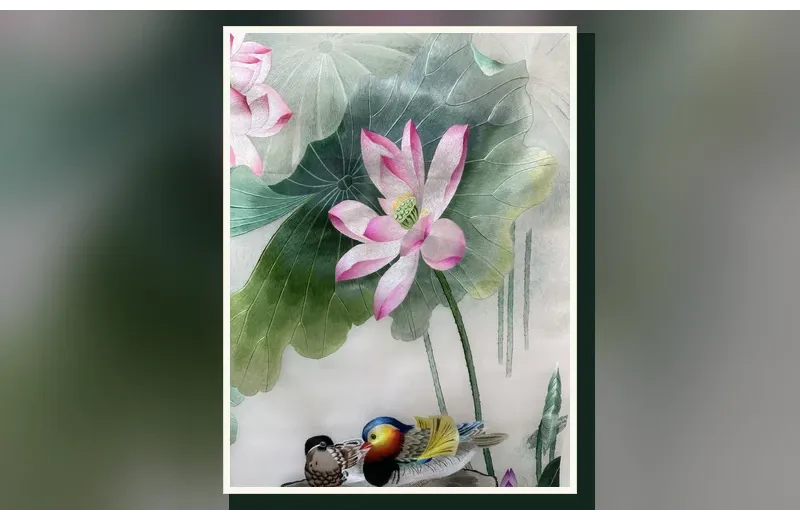
Ask why Su Xiu looks like a painting rather than like needlework, and the honest answer is mostly logistics: somebody has hundreds of subtly different shades of silk on hand.
Not a palette — a library
Standard embroidery floss comes in a fixed set of colours. A Su Xiu studio keeps long graded runs instead: ten greys that step from warm mist to cool stone, eight pinks that move through a peony, a dozen greens for bamboo alone. The difference between two neighbouring skeins can be almost invisible on the spool and completely visible in the finished gradient.
Dyeing for gradation
Silk takes dye beautifully, which is both a gift and a problem: small changes in dye bath, time or temperature shift the shade. Traditional practice relies on experienced dyers producing controlled, repeatable batches; modern studios also keep careful records so a run can be replenished mid-piece. For a commissioned work, shades may be dyed specifically for that image.
- Selection happens in daylight. Skeins are compared against the reference painting under neutral light, never under warm bulbs.
- Shades are sequenced. They are laid out in order from light to dark for each area of the composition.
- Silk changes with direction. The same skein stitched at a different angle reflects differently — an effect used deliberately, not an inconsistency to hide.
Colour and light in the finished piece
Real silk has a soft, shifting lustre. Turn a framed panel a few degrees near a window and the shading will change subtly as different stitch directions catch the light. Synthetic thread stays flat and uniformly bright. This is the easiest single test for material quality, and it is also why photography rarely does a good panel justice.
The time cost
Sorting, dyeing, re-threading for every shade change and keeping dozens of near-identical skeins in order is a substantial part of the roughly three months a panel takes. It is invisible work — no one sees it in the finished object — but without it the gradients that define Su Xiu simply cannot be made.
Related: Pure Silk Thread, Splitting a Silk Thread and caring for dyed silk.