


Why One Hand-Embroidered Panel Takes Three Months
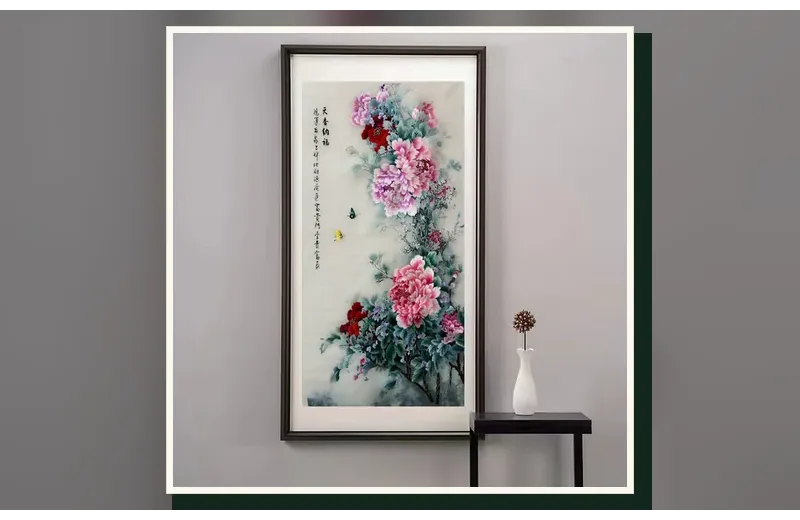
"About three months" is the answer we give most often, and it is not a lead time padded with a queue. It is the working time of one experienced embroiderer on one panel.
What actually fills the weeks
Week 1–2 — preparation. The reference painting or photograph is studied and adapted to the panel's proportions. The outline is transferred to silk stretched on a frame. Dozens of graded silk shades are selected or dyed and laid out in order. This stage is mostly decisions, but a wrong decision here costs weeks later.
Week 3–8 — the ground. Large areas are filled with fine flat stitches: backgrounds, foliage, broad colour fields. Progress is visible but slow, and the work must stay perfectly even in tension. This is the quietest and largest part of the job.
Week 9–12 — the image. Shading is built up, forms are modelled, and the fine detail is added: eyes, whiskers, petal edges, the line of a branch, the last highlights that make a surface look alive. The embroiderer repeatedly steps back to judge the whole piece, and often reworks an area whose tone is slightly off.
Finally — finishing. The panel is cleaned, removed from the frame, mounted or framed, checked from both sides and photographed in daylight before packing.
Why you cannot simply add people
Two embroiderers shade differently. Even when both are highly skilled, the boundary between their work shows — in stitch direction, tension and the exact way they mix two colours. A panel worked by one maker has a consistent hand across the entire surface. That consistency is part of what a collector is buying, so a single piece normally stays with a single person from outline to finish.
What changes the estimate
- Size. More surface means more ground stitches, roughly in proportion to area.
- Density of detail. A single peony and a full landscape of mountains, mist and trees are very different amounts of work at the same size.
- Technique. Random stitch and double-sided work are notably slower than flat ground work.
- Revisions. Custom commissions include progress reviews, and adjustments mid-piece are far easier than repairs after mounting.
What three months means for you
It means a commission for a specific date should be started early. It means a very low price for a large "hand-embroidered" panel deserves a question. And it means the object is genuinely one-off: nobody can produce a second identical copy in an afternoon, because there is no file to reprint from.
Meet the maker in A Day in the Life of a Suzhou Embroiderer, or see Made by Masters.