


Made by Masters
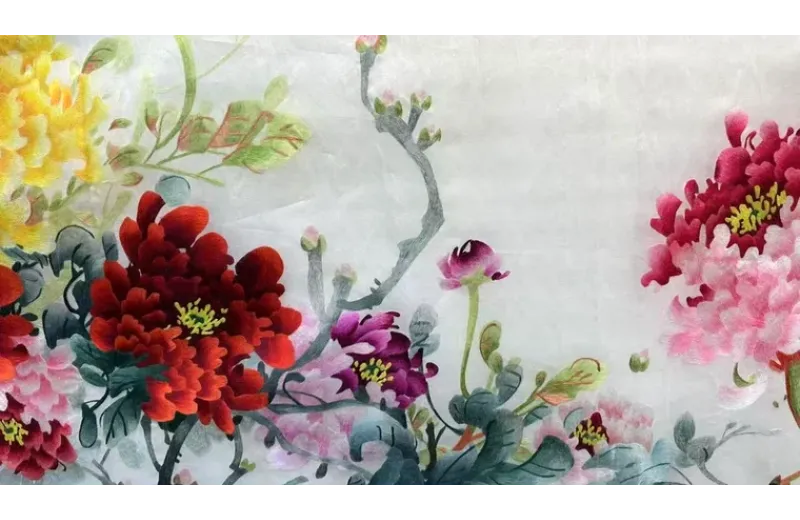
A Suzhou silk embroidery panel is not printed, woven or machine-stitched. It is built one needle movement at a time, by one embroiderer, over roughly three months at the frame.
What "handmade" actually means here
The silk ground is stretched taut on a wooden frame and kept under even tension for weeks. The embroiderer works with a needle barely thicker than a hair, passing a split silk filament through the fabric, then checking the surface from both sides. There is no programme, no repeat pattern and no automatic colour change: every stitch length, direction and shade is decided at the moment it is placed.
This is why a finished Su Xiu panel has no visible "grain" the way a woven or printed textile does. Look closely at a petal and you will see hundreds of tiny, slightly different stitches laid so that light catches them at different angles. That optical softness is the signature of the craft.
Three months at the frame
A mid-sized panel with a reasonably detailed subject typically takes an experienced embroiderer around three months of steady work. Larger, denser compositions take longer. The time is not spent on one difficult operation but on tens of thousands of small ones:
- Weeks 1–2: studying the painting, transferring the outline to silk, and dyeing or selecting the thread shades for every colour transition.
- Weeks 3–8: laying the ground stitches, building the main forms, and working the long, patient areas of background and foliage.
- Weeks 9–12: shading, fine detail — a cat's whiskers, the edge of a peony petal, the line of a mountain ridge — plus finishing, cleaning and mounting.
Where Su Xiu fits
Su Xiu — Suzhou embroidery — is one of China's Four Great Embroideries, alongside Xiang (Hunan), Shu (Sichuan) and Yue (Guangdong). Its defining features are exceptionally fine split silk thread, an even flat surface, delicate colour gradations and, at its most demanding, double-sided work where both faces of one piece of silk are equally finished. The tradition grew out of the silk-producing Jiangnan region and was refined over centuries in Suzhou's workshops and studios.
Why the maker matters
Shading is the last skill a student learns and the first thing a collector notices. It commonly takes years of apprenticeship before an embroiderer is trusted with the face of an animal or the transition across a silk sky. Our pieces are worked by embroiderers trained in that Suzhou tradition; a single piece stays with one maker from outline to finishing, so the hand behind it stays consistent.
Every panel in our collection is hand-stitched by a single embroiderer. Browse the collection or read why one panel takes three months.